
The Science of a Good Pillowcase
Comfort and fit guidance, not medical advice.
Sources checked 25–26 Oct 2026 (AEDT). Products and prices (checked 26 Oct 2026): best pillowcase guide; check at retailer before you buy.
Quick answer
No single case is best. Match it to what bugs you:
- Run hot? Hot sleepers often prefer crisp, airy linen or cotton percale.
- Want smooth and slippery? Silk had the lowest friction of the fabrics in one independent lab test [S1].
- Want to hot wash? Cotton or linen. Silk can't take a 60 °C wash.
👉 Take the 2-minute quiz: get the pillow right first, then the case.
1. Friction: why silk feels "slippery"
In one independent lab friction test, silk had the lowest friction of the fabrics tested; velvet had 37.4% more friction than cotton and 76.5% more than satin [S1].
- You'll see figures like "34% less friction" or exact friction numbers online. We couldn't trace them to a primary source, so we don't quote them. We plan to measure friction ourselves and publish the method.
- Satin is a weave, not a fibre. A "satin" case may be polyester.
2. Moisture: how much water a fibre holds
ASTM's standard table lists commercial moisture regain (water a fibre holds relative to its dry weight) of 12% for flax (linen), 8.5% for cotton and 0.4% for polyester [S2]. These are agreed trade values, not lab measurements, and real fabrics vary. Linen and cotton soak up and release sweat; polyester holds very little, so sweat can sit on the surface.
3. Temperature: weave matters as much as fibre
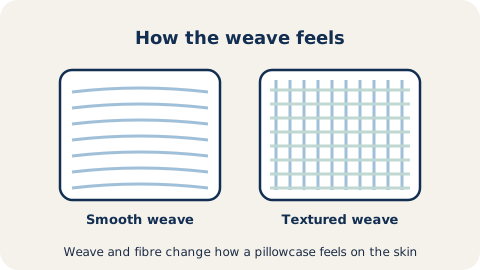
- Percale is a plain one-over-one-under weave; sateen has long floating threads. Some people prefer the crisp feel of percale.
- A 2024 University of Sydney systematic review found 9 studies comparing fibre types in sleepwear and bedding. Only one included study tested linen bedding (a small nap study in mild humid heat comparing linen sheets, bed pad and pillowcases with a cotton/polyester set), and the review's authors said no conclusion can be drawn for bedding from one study [S4]. It did not report how cool or comfortable people felt. (Two authors received wool-industry funding, declared in the paper.) Many hot sleepers simply prefer the feel of linen; that's a comfort preference, not a research finding.
- Silk feels cool when you first touch it. Claims that it "regulates temperature" are unproven.
- Our wider take on cooling bedding: it can feel cooler, but trials haven't shown clear differences in sleep measures (evidence).
4. Thread count and momme: the numbers on the label
- Thread count only means something when you compare the same fibre and weave. Above about 400 it's mostly marketing, especially with multi-ply yarns. That's industry consensus rather than formal research.
- Momme is silk's weight. Around 19–25 momme is common for pillowcases, and heavier usually lasts longer. This is industry convention, not a studied threshold.
5. Washing: the part that really counts
- Wash and dry per the care label; many people wash pillowcases weekly.
Which case suits you? (comfort guide)
| You... | Try | Why | Care |
|---|---|---|---|
| Run hot | Linen or cotton percale | Some people prefer a crisp, airy feel (comfort preference) | Follow the care label |
| Like a smooth, slippery feel | Mulberry silk (19–25 momme) | Lowest friction of the fabrics in one lab test [S1] | Gentle cycle, cool water |
| Want "set and forget" | Cotton percale | Durable, easy care | Follow the care label |
| Like a soft, smooth feel | Cotton sateen | Smoother feel, a bit warmer | Follow the care label |
| Want low effort and smooth | Lyocell | Smooth feel (friction data is weak) | Check label |
Product picks: see our best pillowcase guide for silk, linen, cotton percale and bamboo lyocell picks, each checked on the retailer's page on 26 Oct 2026.
Sources
Sources: accessed 25–26 Oct 2026 AEDT.
- [S1] Kang X. "The Fabric Factor: The Role of Your Pillowcase and Hair Accessories in Hair Care." TRI Princeton, 4 Dec 2023. https://www.triprinceton.org/post/the-fabric-factor-the-role-of-your-pillowcase-and-hair-accessories-in-hair-care
- [S2] ASTM D1909-13 (Reapproved 2020)ε1, Standard Tables of Commercial Moisture Regains and Commercial Allowances for Textile Fibers, Table 1. ASTM International. doi:10.1520/D1909-13R20E01. https://store.astm.org/d1909-13r20.html
- [S4] Li X, Halaki M, Chow CM. How do sleepwear and bedding fibre types affect sleep quality: a systematic review. J Sleep Res. 2024;33(6):e14217. doi:10.1111/jsr.14217. PMID 38627879.
Comfort and care guidance, not medical advice.